

Although they seem similar concepts and they are closely related, in reality there is some important difference between participation share and property coefficient. It is very easy to confuse both concepts, when it comes, for example, to the distribution of expenses or benefits in communities of owners.
At Meridional we like to make accessible to all our owners, whether foreigners or nationals, some concepts that may seem complex at first, but are essential to assert their rights and obligations with respect to the community where they live.
The importance of knowing the difference between participation share and ownership coefficient
The main difference between the participation share and the ownership coefficient of a property is that the first can change over time and, to calculate it, various factors. On the other hand, the property coefficient is always a objective value and that cannot be modified. The latter, for its calculation, uses as a reference the surface of the property.
It is very important to know the difference between participation share and ownership coefficient when it comes to making the distribution of expenses, fees and benefits in communities of owners. It is only when it comes to semi-detached flats or chalets that these two concepts appear; If it is a home single family independent (attached or not to another home) then these concepts do not have to be taken into consideration.
When a Community of owners wants to make the distribution of expenses and benefits, it must take as reference the participation share and not the property coefficient, which is what is usually done in some cases, and which is established from the moment of the construction of the property and it is the builder who determines it when selling the building.
What is the Participation Share?
The participation share in a property refers to the proportion or percentage of ownership that a co-owner has in a building, house or land. It is a term commonly used in the field of condominium, where owners share certain common areas, such as gardens, hallways and elevators.
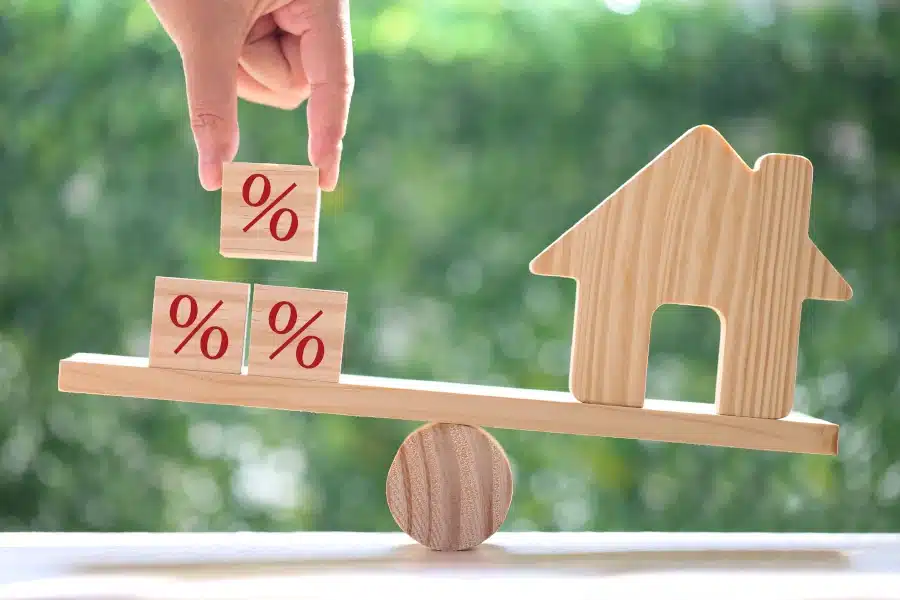
The participation share is a monetary contribution that each of the owners that make up the community of owners does. The participation share is regulated in article 5 of the Horizontal Property Law, which establishes the way to calculate how much each has to contribute owner to the community. That is why it is said that the share, unlike the coefficient, is variable: Not all neighbors contribute the same amount.
To calculate the participation share of each owner It is taken into account:
- The useful surface of each of the properties that make up the building and its relationship (percentage) with the surface of the entire block (building).
- If he property It is interior or exterior.
- Which is the situation of the home.
- The use of common services of the building. For example, in a community, not all residents use the roof, but only those who live on certain floors.
In this way, the participation share is made up of a value share and a functional share. The value share is what allows you to calculate the value of each property according to its useful surface and the location or site of the same (interior or exterior); In addition, it is made up of a functional or use fee, which is the value of the property according to the common elements whether said property is going to be used or not. A neighbor without a parking space, for example, would not have to pay for electricity or cleaning the building's common parking lot.
Importance of the Participation Share
The participation share is vital to determine the responsibilities and rights of each co-owner in relation to maintenance, expenses and important decisions that affect the community of owners. This figure also plays a fundamental role in the calculation of common expenses and the equitable distribution of burdens among residents.
Property Coefficient: What Does It Involve?
On the other hand, the property coefficient refers to the indivisible fraction that represents the proportional part of each co-owner in relation to the entire property. It is a measure used to determine the economic contribution of each owner to the costs of maintenance and improvements of the property in question.
Also called co-ownership coefficient, is an objective value and is established based on the surface of a property, as well as the surfaces that occupy common areas in a building. Common areas can be stairs, elevators, portals, swimming pools, corridors, green areas, etc.
Key Difference Between Participation Share and Ownership Ratio
The main difference between the participation share and the property coefficient is that the latter does not change over time. When doing the sum of the square meters of all properties, including the common areas, you get the surface of a building. The property coefficient is expressed in percentage figures that are granted to each of the homes or premises of a building that is organized horizontally. Thus, by adding all these percentages, the result will always be 100%.
Although both represent portions of property, the difference lies in their specific applications. While the participation share focuses on the proportion of rights and duties of each co-owner in a community of owners, the property coefficient is used to evaluate the financial contribution of each owner in the common expenses and improvements of the property.
Importance of Understanding the Differences
It is crucial to understand these differences to avoid misunderstandings and conflicts between owners. By having clarity about the concepts and their application, better management and decision-making is facilitated in relation to the maintenance, repairs and necessary improvements in the shared property.
In summary
In conclusion, the participation share is related to the rights and duties of the co-owners, while the ownership coefficient refers to the economic contribution of each owner. Both concepts play fundamental roles in the efficient management of a shared property, thus promoting harmonious coexistence and proper use of common resources.


 Español
 English (UK)
 Français
 Deutsch (Sie)